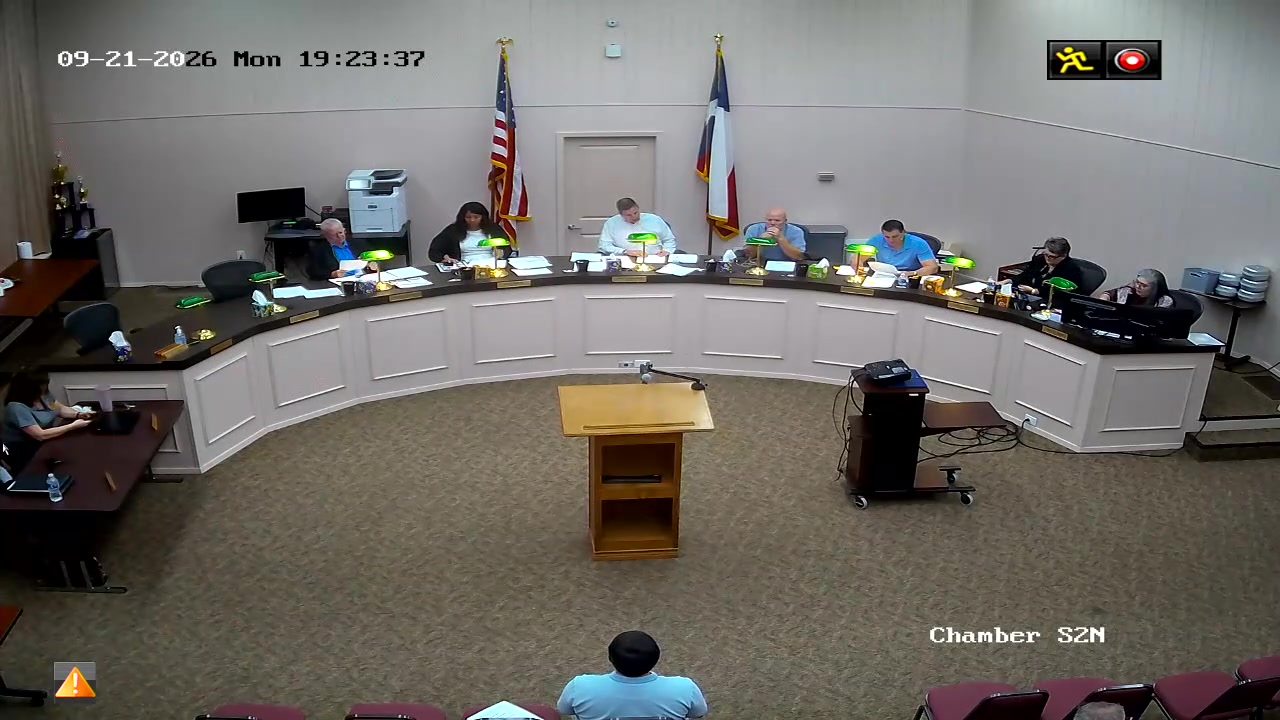
“We Have The Carrot. There Needs To Be The Stick.” Farmersville’s Economic Development Board Debates How To Fill Downtown

On South Main Street, the second floor of the building at 138 S. Main has no tenant and no easy way in. The upstairs front door sits about 30 inches above the sidewalk.
On Oct. 22, the Farmersville Economic Development Corporation agreed to pay $40,991 to put fire sprinklers on that empty floor. Later the same night, the board spent a long stretch of the meeting on a bigger question: what would it take to get people back into buildings like it?
The answer it landed on was letting people live upstairs, and the board wants the City Council to take up the question.
What The Rules Say Is Unclear
Downtown Farmersville sits in what the city calls the Central Area District, and the board didn’t agree on what the rules there allow. One member believed only a building’s owner, not a renter, can live upstairs. Another said no one can live on a ground floor.
Some owners would build out their second floors for living space if they could, a member said. “But we’re not allowed to,” came the reply.
“It was political, from what I understand,” one speaker said. “It’s nothing to do with reality.” Another called it “an artificial limitation.”
A copy of the city’s zoning ordinance posted on a third-party code website suggests the picture may be more complicated. It appears to allow residential use downtown with a specific use permit, a separate approval from the city, and only as a secondary use after a business is established in the building. Whether that copy is current could not be confirmed with the city before publication.
If upstairs living is already possible through a permit, the question for council may be less whether to allow it and more whether the process makes sense for owners of century-old buildings. If the rules are as strict as some on the board believe, council would be deciding whether to loosen them.
One participant said he would raise the idea with a city contact the following week to open a dialogue. The board agreed the conversation has to start with council rather than Planning and Zoning, and that a representative would likely need to present it.
The Math That Keeps Buildings Empty
The case for upstairs housing comes down to money.
“It’s a cost issue,” one member said. The downtown buildings that are occupied have mostly been renovated, he explained. The ones that sit empty need so much work that owners are unlikely to spend the money to attract a tenant, because the rent it would take to pay for a renovation is more than Farmersville can command compared with McKinney and other nearby cities.
Upstairs rent could close part of that gap. A board member said rental units “would help cash flow it” and encourage owners to invest. Another warned against the opposite problem, a building with a tiny storefront and the rest turned into living space, and suggested an ordinance could cap the residential share at half.
Denison came up as a model, though one speaker noted its downtown revival has been mostly private. That kind of turnaround usually happens when one investor buys several buildings and puts millions into them at once. Farmersville’s downtown is split among many individual owners, and with interest rates where they are, “it’s got to be people with cash,” one member said.
Another put the stalemate more bluntly: “Everyone’s waiting until it happens.”
A 30-Inch Step
The building at 138 S. Main shows how the problems pile up.
Owner Clay Potter told the board his first and second floors have no internal connection. Before he bought the building, a ramp was added out front to make the ground-floor entrance accessible. That left the separate upstairs door with what he called “about a 30 inch step.” Asked about plans for the upstairs, Potter said he would like to use it, but “we need the city’s help.”
About four years ago, Potter said, the city had grant money for downtown sidewalk work. Crews painted markings on his sidewalk, and he was told the plan was to level it, add steps and finish accessibility work. “And then they just ran out of money,” he said. The markings have since worn away. Another speaker said a nearby building had been told the same thing.
The city carried out a federally funded downtown sidewalk project in 2023 that state records list as closed. It was a $328,750 Texas Community Development Block Grant project covering Main Street, Farmersville Parkway and Washington Street. The meeting did not address whether Potter’s stretch was ever part of that work. The city’s current project list includes a proposed repair of about 5,850 square feet of downtown brick along Main and McKinney streets, and that project description specifically excludes sidewalk construction.
The sprinkler grant comes from the FEDC’s Fire Suppression Grant program, which covers the full cost of sprinkler systems in downtown buildings, a major cost in reopening an older building for restaurants or larger gatherings. The program proved popular quickly: by March 2025 the board was asking council for a $200,000 budget amendment because its funding was nearly gone. Potter called the program “absolutely fabulous.”
The Carrot And The Stick
One board member offered what was billed as an unpopular opinion. “We have the carrot here,” the member said, referring to the FEDC’s grants. “There needs to be the stick.”
The proposal was a vacancy permit program that would push owners of long-empty buildings to invest in them or sell them. Several Texas cities already do this. Beaumont adopted a vacant building registry in 2024 that requires owners of vacant buildings in its central business district to register with the city and pay an annual fee and inspection. Laredo charges downtown commercial owners a registration fee that rises from $300 to $750 the longer a building stays empty.
The idea didn’t get far. Another member said something similar had come up before and was not well received at the City Council. No action was taken.
A Recruiter Told To Stay Off Main Street
The board did take one concrete step. It voted to hire The Retail Coach, a national retail recruiting firm, under a $30,000 annual contract already in the budget. Elise Bobitt made the motion, and it passed without opposition.
The firm contacts national retail, restaurant and commercial prospects for the city and tracks them in an online portal. It replaces the board’s work with Retail Strategies, which was useful for demographic data but produced only a few leads that went nowhere. Staff said Retail Strategies had quoted about $47,000 for a comparable package.
Because the new firm works mostly with national brands, staff said they had given its leader, Aaron Farmer, two instructions: keep national name brands out of downtown, and focus on the highway. “To coin Austin’s term, you want to keep downtown weird,” one member said. Staff said the city can tell the firm to stop talking to any prospect before negotiations begin.
That instruction appears to be the only protection downtown has for now. Asked whether the city could legally keep a national chain off Main Street, a board member said he had raised the question before without getting traction. “McKinney did it, from what I understand,” he said, but the board’s legal representative wasn’t sure how.
The longer bet is that businesses along U.S. 380 will bring more traffic and sales tax, and that this will eventually make downtown renovations pencil out. There are signs of life in the meantime. One member pointed to recent openings, including a burrito spot, a coffee shop and a burger restaurant on the way, along with roughly 3,600 homes planned or underway in new subdivisions.
The board agreed to keep downtown on its agenda every month.
“Otherwise it’s going to look like this for the next five years,” one member said.